TRACEABLE EVIDENCE DATASET + RESEARCH ATLAS

Harness RSI.

Same model.
A different way to work.

A curated dataset of reported harness changes and outcomes. Trace what changed, what helped, what failed, and what the evidence cannot establish. Explore the comparisons or download a versioned snapshot.

Read the paper (PDF) Meet the authors Source-linked. Versioned. Built to grow.
THE EDITABLE LAYERH → H′
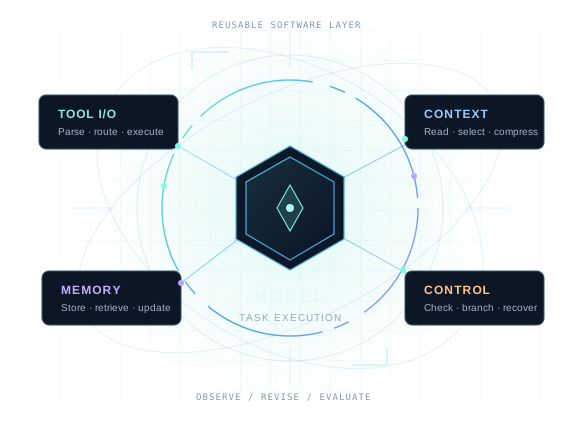
Tools, context, memory and execution control form an editable harness around the task model.

Preserve a multiline edit as a file payload instead of dispatching its contents to the shell.

Inspect the reported change ↗
RESEARCH SNAPSHOT

— evidence records

— collected papers

Evidence through

View updates ↗

THE RESEARCH QUESTION

What changed.
What worked. What carries over.

What changed in the harness? What did that change accomplish? Under which conditions might it be useful again?

An agent’s harness is the prompts, tools, memory and execution logic around its model. Our survey connects how the improvement workflow works, whether the improvement procedure itself changes, and what reusable mechanisms emerge across tasks.

A FEW CHANGES, UP CLOSE

Concrete edits. Measurable consequences.

Selected results from different studies and settings. Each card states what was measured; these are not head-to-head comparisons.

01 / INSIDE THE RESEARCH

A loop that edits
the way an agent works.

A harness change persists beyond one answer. Follow a candidate from proposal to execution, evidence and reuse.

Retained versions + optimization history inform the next proposal

THE RECURSIVE QUESTION

Does the improver
change too?

HARNESS OPTIMIZATION

A fixed improvement procedure searches for better task-agent harnesses.

RECURSIVE REUSE

A revised agent, improvement skill or search policy participates in generating later revisions.

Task gains alone do not establish better subsequent optimization or general RSI. Our survey examines reported configurations and their evidence separately. Related RSI framework ↗

02 / CROSS-DOMAIN DISCOVERIES

Shared problems.
Different repairs.

Choose a question, then compare two domains.
See the shared function, the actual edits and the conditions for reuse.

Follow each comparison to the source-linked observation, then explore the underlying benchmark records in the atlas below.

03 / THE EVOLUTION ATLAS

See the change itself.

Four task domains. Concrete before-and-after changes.
Representative evidence and its limits, together.

Coding

Selected synthesis from the survey’s domain evidence. Each card compares reported reusable changes; it is not one shared implementation or one experiment.

THE DATA / REPORTED, NOT REPRODUCED

Keep the failures.
Trace the claims.

A versioned evidence dataset, not a leaderboard.
One row is a source within a task subcategory—not an independent intervention.

v0.1.0 · released 2026-10-1895 category–source records · evidence through 2026-10-01

4/95 records screened for structured signals · 6 scoped observations · 91 not yet reviewed

The 95-record survey snapshot is unchanged. Outcome/retention labels are a selected pilot screened from existing curated text, not a new independent audit of every source. Unreviewed ≠ no failures; usage ≠ benefit; retained ≠ effective. No dataset-specific reuse license has been granted.

What these labels do—and do not—mean

One record may contain multiple outcomes under different comparisons. Each signal has a scope, attribution type, retention status, exact supporting record excerpt, and inherited source locator. Empty benchmark applicability does not mean every benchmark. The remaining records and reserved control/selection fields are explicitly unassessed. This is not a representative sample of attempted edits; do not calculate a global success or failure rate. The separate living bibliography below includes newer papers that have not entered this evidence snapshot.

04 / THE EVIDENCE NOTEBOOK

Your benchmark.
The changes behind the score.

Explore what a harness can change, what was actually observed, and what the comparison supports. Every record keeps its original setting and source.

Loading benchmark evidence…Download evidence JSON ↓

CURRENT VIEW

SWE-bench Verified

What can change?

Comparative synthesis

What is the evidence?

Open a record for the starting harness, exact change, observed result, retention status and primary-source location. Missing details stay visible.

Records and labels are not counts of independent improvements.

05 / LIVING COLLECTION

A collection that keeps growing.

Publication trends and actual collection updates.
Explore cumulative growth or monthly activity.

—Papers in the collection
—Published in the latest year
COLLECTION UPDATED—Search through

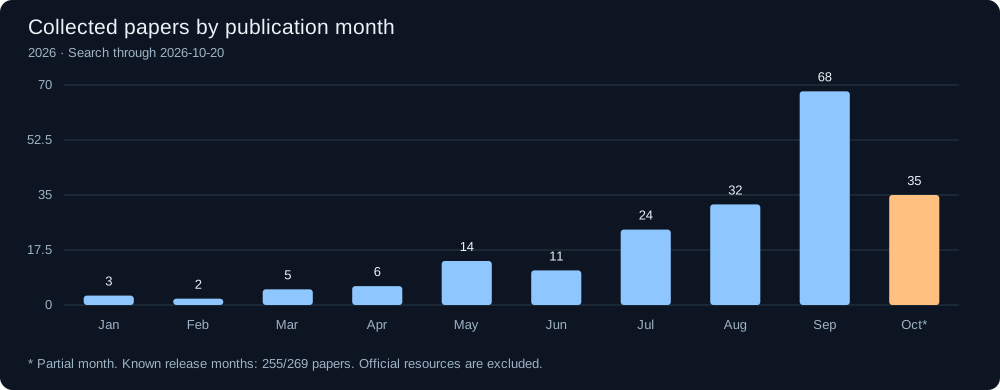
Papers by publication month

Included literature · monthly counts

Monthly publication counts for the collected literature. Detailed values load with JavaScript.
Collected papersThe current month is partial.

View monthly values
Publication counts
MonthPapersCumulative
About these numbers

Counts cover the survey collection, including related methods, surveys, and benchmarks.

Publication months use first arXiv submission where available, otherwise bibliographic publication dates.

What the October 20 literature update adds

Recursive reuse: Harness², RSIFlow and Harmony Harness distinguish task-harness changes, retained improvement guidance and supplied search machinery.

Failures and generalization: failure-feedback directedness, GSO and Harness Evolution Hits a Ceiling separate target repair, regressions, held-out effects and trained-model carryover.

Memory and definitions: MemSkill, ERSkill, SESA and Self-Evolving Agent Harness distinguish stored content, reusable procedures, trained policies and conceptual scope.

Read the source-linked comparison supplement ↗

This targeted synthesis covers already-collected literature through October 20 and is now incorporated in the revised GitHub reading PDF. The October 19 PDF remains archived; submitted manuscripts and the dataset are unchanged. The frozen evidence still covers October 1: 95 records, dataset v0.1.0. Unreported failures are not recovered by this update.

COLLECTION UPDATES

Loading collection history…

06 / BUILT TO KEEP EVOLVING

A living companion,
beyond the paper.

The paper captures a research snapshot.
This atlas is where the evidence keeps growing.

Evidence & website updates

Download update history ↓

Suggest a study ↗ · Correct an evidence record ↗ · Read the curation guide ↗. Community suggestions and source-backed corrections are welcome.

07 / HOW TO READ THE ATLAS

Follow the evidence,
all the way back.

Useful comparisons need more than a headline score. Here is what the records do—and do not—tell you.

01 / STARTING POINT

Seed capability

02 / THE INTERVENTION

Concrete harness edit

03 / WHAT WAS OBSERVED

Outcome + evidence limits

04 / CHECK IT YOURSELF

Primary source + locator

Download the full evidence collection ↓
What counts as an evolved harness?

A reusable change to the prompts, interfaces, tools, context handling, skills or control logic around a target model. A one-off answer, generated image or task patch is not automatically a harness change. The records distinguish supplied mechanisms from modifications discovered during evolution.

Why are the literature and evidence counts different?

The living bibliography includes surveys, benchmarks and adjacent methods. The frozen domain evidence is a narrower set: 95 category–source records from 62 research papers and one benchmark resource. A paper can contribute a record to more than one task category.

How strong is an improvement claim?

Read the evidence label. A full-system gain does not isolate one edit. An ablation tests the components actually removed; a paired case remains a case. A rejected or unused proposal is not presented as a final retained capability.

Can I reuse a pattern in another domain?

Use it as a design hypothesis. Compare the failure trigger, available observations and corrective actions. An analogy across domains is not an established transfer result; unchanged-harness transfer is identified separately when reported.

How is this resource kept current?

New studies are screened, concrete revisions are traced to primary sources, and comparisons are revised when the evidence changes. Dated release notes distinguish website changes, evidence updates and bibliography imports. The paper’s October 1, 2026 evidence snapshot remains identifiable.

08 / PROJECT

Follow the research.

Read the evidence, reuse the data,
or suggest a paper or correction.

01 / READ

The survey

From Harness Optimization to Recursive Self-Improvement: A Survey of Language Model Agents. Revised author preprint, 20 October 2026; 74 pages, independent non-ACL layout; not peer-reviewed. The October 19 reading copy remains archived in GitHub; submitted manuscripts are unchanged.

Read the survey (PDF)
02 / EXPLORE

The living bibliography

Curated sources, classifications and publication-date provenance.

Download BibTeX

09 / THE TEAM

Behind the research.

The survey and its living research companion.

SURVEY AUTHORS

    Project development & assistance

    HARNESS RSI / FIGURE VIEW

    Research figure

    Download ↗